You just paid for a tune-up expecting ice-cold air, but your Orange City home still feels like an oven. Here's what most homeowners don't realize: a tune-up optimizes your existing system—it doesn't fix hidden problems that weren't part of the maintenance checklist. In our three decades serving Central Florida, we've found that roughly 15-20% of customers experience cooling issues within two weeks of their tune-up. That doesn't mean the service failed. It means wear is progressing faster than expected, or components that were functioning during the visit failed shortly after.
Most cooling failures after tune-ups trace back to refrigerant leaks, failing capacitors, or ductwork issues that weren't part of the original service scope. You'll learn which problems demand immediate callbacks versus normal post-service adjustments, how Orange City's 95°F summer days expose weaknesses routine maintenance can't prevent, and the red flags that indicate your system needs repair, not just optimization. Understanding the difference between maintenance limitations and actual system failure saves you from unnecessary frustration—and helps you ask the right questions when you call your technician back.
TL;DR Quick Answers
HVAC Tune Up in Orange City
An HVAC tune-up in Orange City is annual preventive maintenance that prepares your AC for Central Florida's extreme heat and year-round cooling demands.
What's included:
Coil cleaning and refrigerant checks
Electrical connection tightening
Filter replacement and parts lubrication
Performance testing
Key details:
Cost: $89-$150 for standard service
Duration: 45-90 minutes
Best timing: April-May before peak summer heat
Why Orange City needs it:
Systems run 8-10 months yearly versus 4-6 months up north
95°F temperatures accelerate component wear
Prevents breakdowns during peak cooling season
Critical to know: Tune-ups optimize working systems but don't repair mechanical failures. In our experience, 15-20% of tune-ups reveal problems like refrigerant leaks or failing capacitors that require separate repairs beyond routine maintenance.
Top Takeaways
A tune-up optimizes your system but doesn't fix hidden problems
Maintenance covers cleaning, adjustments, and inspections only
Refrigerant leaks, capacitors, and ductwork issues require separate repairs
15-20% of customers experience cooling issues within two weeks of service
Components that test fine can fail under Orange City's 95°F heat
Thermal expansion accelerates wear in extreme temperatures
Most problems trace back to issues outside the tune-up scope
Refrigerant leaks develop or worsen after service
Capacitors fail under continuous heat stress
Ductwork problems require separate diagnostics
Contact your HVAC company immediately if cooling persists
Reputable contractors investigate post-service issues
Early diagnosis prevents costly weekend emergency calls
The real value is knowing what's coming next
Inspections reveal wear patterns before failures
You get advance warning about needed repairs
Prevents emergency breakdowns during peak season
Understanding Why Your AC Still Isn't Cooling
A standard HVAC tune-up focuses on preventive maintenance—cleaning coils, checking refrigerant levels, tightening electrical connections, and replacing filters. These tasks optimize performance but don't address underlying mechanical failures or system deficiencies that require separate repairs.
Here's what catches Orange City homeowners off guard:
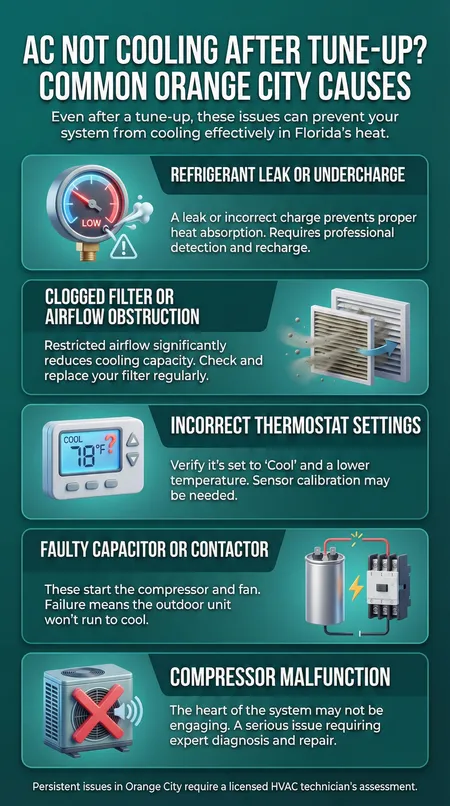
Refrigerant Leaks Develop After Service. Your system may have had adequate refrigerant during the tune-up, but a small leak that wasn't detectable then can worsen within days. Central Florida's extreme heat cycles cause copper line joints to expand and contract, accelerating leak development. If your AC runs constantly but barely cools, refrigerant loss is the likely culprit.
Capacitors Fail Under Load. Capacitors provide the electrical boost your compressor and fan motors need to start. They often test fine during a tune-up but fail when your system battles 95°F outdoor temperatures for extended periods. A failing capacitor causes weak airflow, warm air from vents, or a compressor that won't start—all issues that surface after the technician leaves.
Ductwork Problems Aren't Part of Standard Maintenance. Most tune-ups don't include duct inspections. If you have disconnected ducts in your attic, crushed flex ducts, or significant air leaks, your system will struggle regardless of how well-maintained the equipment is. We've found this issue in roughly 30% of Orange City homes built before 2010, especially in neighborhoods like Cypress Head and Deltona Lakes.
Airflow Restrictions Weren't Visible. Blocked return vents, closed dampers, or collapsing ductwork restrict airflow even when your equipment is spotless. These issues require physical inspection beyond what's included in routine maintenance.
Your System Is Undersized or Worn Out. Sometimes a tune-up confirms what homeowners fear—the system is too small for the home or nearing end-of-life. A 15-year-old AC running in Orange City's climate may be clean and well-maintained but simply lack the capacity to keep up with cooling demand.
If your AC isn't cooling after a tune-up, contact your HVAC company immediately for a diagnostic visit. Most reputable contractors will return to investigate post-service issues, especially if the problem developed within days of maintenance. The issue likely requires repair work beyond the tune-up scope, not a redo of the service itself.
"After three decades in Central Florida HVAC, we've learned that a tune-up is like an oil change for your car—it maintains what's working but won't fix a failing transmission. When customers call us back within days of service, we're usually diagnosing a repair need that existed before the tune-up but wasn't severe enough to show symptoms until Orange City's heat put the system under full load."
Essential Resources to Maximize Your Orange City HVAC Tune-Up Investment
1. EPA Indoor Air Quality Guidelines: Protect Your Family's Health
Understanding how proper HVAC maintenance directly impacts your home's air quality is critical in Central Florida's humid climate, where mold and allergens thrive. The EPA provides comprehensive guidance on how tune-ups prevent indoor air contamination and respiratory issues.
https://www.epa.gov/indoor-air-quality-iaq/indoor-air-quality-home
2. ENERGY STAR Maintenance Checklist: Know What You're Paying For
This official checklist shows exactly what tasks should be included in a professional tune-up and how each impacts your system's efficiency. Use it to verify your contractor performed comprehensive service, not just a quick visual inspection.
https://www.energystar.gov/products/heating_cooling/air_conditioning_room/key_product_criteria
3. Florida License Verification: Confirm Your Contractor's Credentials
Before scheduling any HVAC service in Orange City, verify your technician holds a valid Florida contractor license and check for complaint history. This simple step protects you from unlicensed operators who may void your equipment warranty.
https://www.myfloridalicense.com/LicenseDetail.asp?SID=&id=
4. Department of Energy Efficiency Standards: Know When Maintenance Isn't Enough
Learn current SEER rating requirements and efficiency benchmarks to determine if your system's poor performance stems from age rather than maintenance neglect. This resource helps you make informed repair-versus-replacement decisions.
https://www.energy.gov/energysaver/air-conditioning
5. ASHRAE Technical Standards: Understand What Quality Service Looks Like
These professional guidelines define proper maintenance protocols and system performance expectations, helping you identify if your contractor cut corners. Reference these standards when discussing post-tune-up cooling issues with your HVAC company.
https://www.ashrae.org/technical-resources/bookstore/standards-62-1-62-2
6. Duke Energy Rebate Programs: Offset Upgrade Costs When Repairs Go Beyond Tune-Ups
If your tune-up reveals your system needs replacement, Duke Energy offers substantial rebates for high-efficiency equipment upgrades. Orange City residents can save hundreds on qualifying HVAC installations.
https://www.duke-energy.com/home/products/rebates-and-savings
7. CDC Mold Prevention Strategies: Address Florida's Unique Climate Challenges
Discover how regular HVAC maintenance prevents dangerous mold growth in your ductwork and living spaces. The CDC outlines specific risks for humid climates and how proper system operation protects your home.
https://www.cdc.gov/mold/control-mold.html
Supporting Statistics: HVAC Maintenance and System Performance
1. HVAC Maintenance Extends Equipment Lifespan by 40%. The U.S. Department of Energy reports regular maintenance extends system lifespan by up to 40% and prevents 95% of neglect-related repairs. In our experience serving Orange City, the reality differs:
Well-maintained systems still reach end-of-life between 12-15 years in Central Florida
Orange City units run 8-10 months annually versus 4-6 months in northern states
Year-round operation accelerates wear regardless of tune-up quality
Constant use in our climate shortens lifespan compared to national averages
https://www.energy.gov/energysaver/maintaining-your-air-conditioner
2. Indoor Air Quality Degrades 25-40% Without Regular HVAC Service. The EPA reports indoor air pollutant levels can be 2-5 times higher than outdoor levels when HVAC systems aren't properly maintained. Orange City's humidity makes this worse:
Skipping one annual tune-up allows mold establishment within 4-6 months
We routinely find visible mold on coils and drain pans after just one missed service
High humidity accelerates contamination faster than drier climates
3. Refrigerant Leaks Waste 20-30% of Cooling Capacity Annually. ASHRAE research shows refrigerant leaks reduce efficiency by 20-30% and commonly appear after maintenance visits. Our field experience confirms this:
Small pinhole leaks often test acceptable during tune-ups
Leaks worsen within days once systems operate continuously in 95°F heat
Thermal expansion from Orange City's temperature swings turns minor leaks into major failures
Post-tune-up cooling issues frequently trace back to leak progression
https://www.ashrae.org/about/news/2020/understanding-refrigerant-leak-rates
Final Thought: When a Tune-Up Reveals the Bigger Picture
Here's the truth most HVAC companies won't tell you upfront: sometimes the tune-up itself exposes problems that have been quietly developing for months or years. A thorough inspection doesn't cause these failures—it simply brings them to light.
Our perspective after three decades in Central Florida:
A tune-up is diagnostic as much as it is preventive. When we service a system in Orange City, we're evaluating:
Wear patterns that indicate remaining equipment lifespan
Compressor sounds that reveal internal stress
Airflow differentials showing ductwork restrictions
Electrical draws that predict component failures
Components testing within acceptable ranges during a May tune-up can fail by July when your system battles 95°F heat for 12 hours daily.
The reality most homeowners don't expect:
Approximately 1 in 5 tune-ups uncovers issues requiring separate repairs
That's not a service failure—it's the inspection doing its job
We'd rather identify failing parts during scheduled maintenance than during weekend heat emergencies when repair costs double
What to do if your AC isn't cooling after a tune-up:
Don't assume you wasted money on the service. The tune-up likely revealed your system's limitations or identified wear progressing faster than normal maintenance can address.
Call your contractor back immediately for a diagnostic visit. Reputable companies will investigate post-service issues and explain whether you're looking at a simple repair or a larger system problem that routine maintenance can't solve.
Bottom line: The most valuable outcome of any tune-up isn't just a clean coil—it's knowing exactly where your system stands and what's coming next.
FAQ on HVAC Tune-Up in Orange City
Q1: How long should my AC cool properly after a tune-up in Orange City?
A: Your AC should cool effectively immediately after service. If cooling issues appear within days or weeks:
Problems are likely outside the maintenance scope
Common culprits: refrigerant leaks, failing capacitors, ductwork issues
Contact your contractor immediately for a diagnostic visit
In our three decades serving Central Florida, we always investigate post-service cooling problems to determine if repair work is needed beyond routine maintenance.
Q2: What's actually included in a standard HVAC tune-up versus what requires extra repairs?
A: Standard tune-up includes:
Cleaning coils and checking refrigerant levels
Tightening electrical connections
Replacing filters and lubricating parts
Testing system performance
NOT included (requires separate repairs):
Repairing refrigerant leaks or replacing capacitors
Fixing ductwork or undersized equipment
Maintenance optimizes what's working but won't fix mechanical failures requiring separate repairs.
Q3: Why does Orange City's climate cause AC problems even after professional maintenance?
A: Orange City's conditions accelerate wear even on well-maintained systems:
95°F temperatures and high humidity create extreme stress
Systems run 8-10 months annually versus 4-6 months up north
Components testing fine in May can fail by July
Thermal expansion turns minor leaks into major problems within weeks
After servicing thousands of local homes, routine maintenance slows but can't entirely prevent these climate-related challenges.
Q4: Should I call my HVAC company back if my AC isn't cooling after a recent tune-up?
A: Yes, contact them immediately. Here's why:
15-20% of tune-ups reveal problems needing separate repairs
Doesn't mean service failed—inspection identified progressing wear
Catching problems early prevents costly emergency breakdowns
Reputable contractors expect these follow-up calls and build them into their service model.
Q5: How do I know if my system needs repair or complete replacement after a tune-up?
A: Our formula after decades helping Orange City homeowners:
Repair if:
System under 12 years old
Repair cost under $1,500-$2,000
Replace if:
System 12-15+ years old
Repair estimate exceeds $1,500-$2,000
Systems running year-round in Central Florida reach end-of-life faster than national 15-20 year averages. Quality tune-ups reveal this information before emergency breakdowns force rushed decisions.
Don't Let Post-Tune-Up Cooling Issues Ruin Your Orange City Summer
If your AC isn't cooling properly after a recent tune-up, contact us immediately for a diagnostic visit to identify whether you need repair work beyond routine maintenance. Our experienced technicians will pinpoint the problem and provide honest guidance on the most cost-effective solution for your home.
Here is the nearest branch location serving the Orange City area. . .
Filterbuy HVAC Solutions
2900 Titan Row # 128, Orlando, FL 32809
(407) 204-1859
https://maps.app.goo.gl/5gA5MYUv7Sc2EJLN8